

Pope Leo XIV’s apostolic visit to France: delivering public gatherings across multiple sites
During Pope Leo XIV’s apostolic visit to France from 25 to 28 September 2026, GL events supported the Diocese of Paris in planning, preparing and delivering the public gatherings on the Paris programme. In three months, the teams coordinated temporary infrastructure, audiovisual production, power, networks and visitor facilities across several sites for an event of profound spiritual and symbolic significance that drew extensive media attention.
From Notre-Dame Cathedral to the Stade de France, and from Place de la Concorde to the Champs-Élysées, each location presented its own challenges. The teams had to adapt these spaces temporarily to welcome worshippers, relay the celebrations and support media coverage, while meeting the protocol requirements of the apostolic visit.
Some events transcend the work of organising them and become part of history,” said Olivier Ginon, Chairman of GL events, at the end of the visit.
Coordinating multiple teams on a tight Schedul
The three-month preparation period covered technical studies, the mobilisation of staff and equipment, site fit-outs and operational planning. This tight schedule required close coordination with the Diocese of Paris and institutional partners.
The project brought together Live by GL events, Jaulin, Décorama, GL events Audiovisual and Power, the Stade de France, Sign’Expo, Hallexpo, Créatifs and Fonction Meuble. Their combined expertise covered event production, temporary infrastructure, site fit-outs, audiovisual systems, power, networks, signage and furniture.
Coordinating these services was as important as delivering each one. Stages and screens needed power supplies, network connections and control facilities. Public areas needed entrances, routes and signage that worked together. This coordination continued throughout the event, through to dismantling and handing back the sites.
Helping worshippers see and hear the célébration
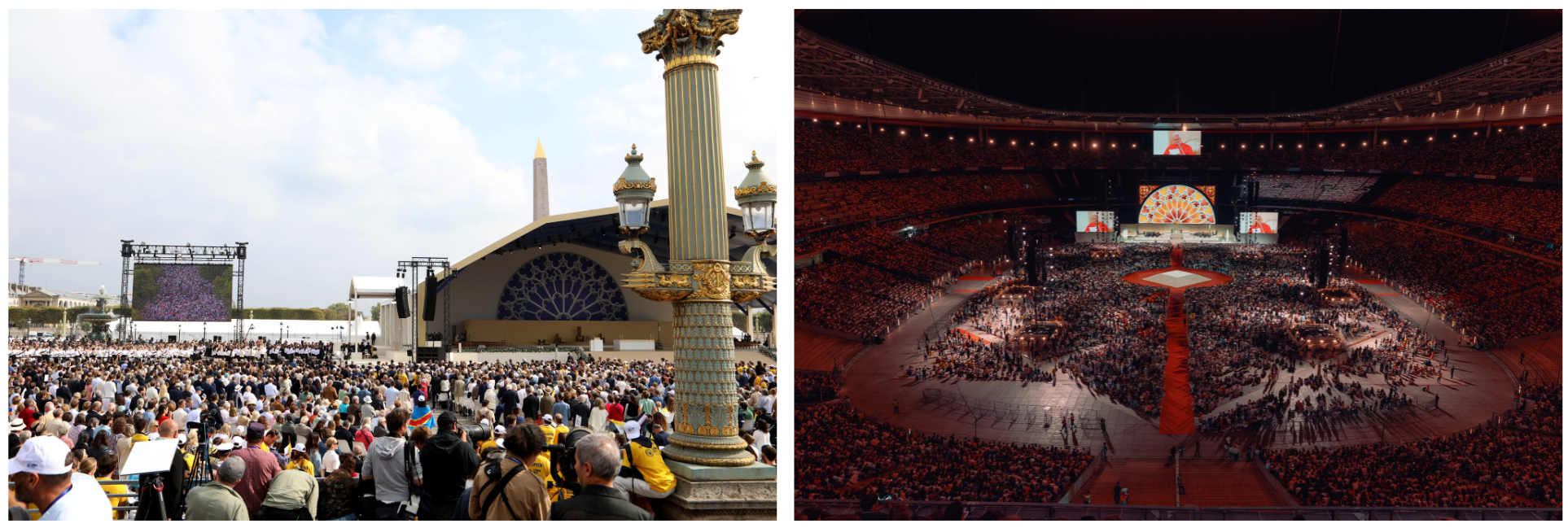
For the Mass, the event footprint extended from Place de la Concorde along the Champs-Élysées to Place de l’Étoile and Avenue de la Grande-Armée. More than 40 large-format screens, around 20 of them trailer-mounted, relayed the celebrations to worshippers across the area. More than 11,000 seats were installed in the stage and audience areas.
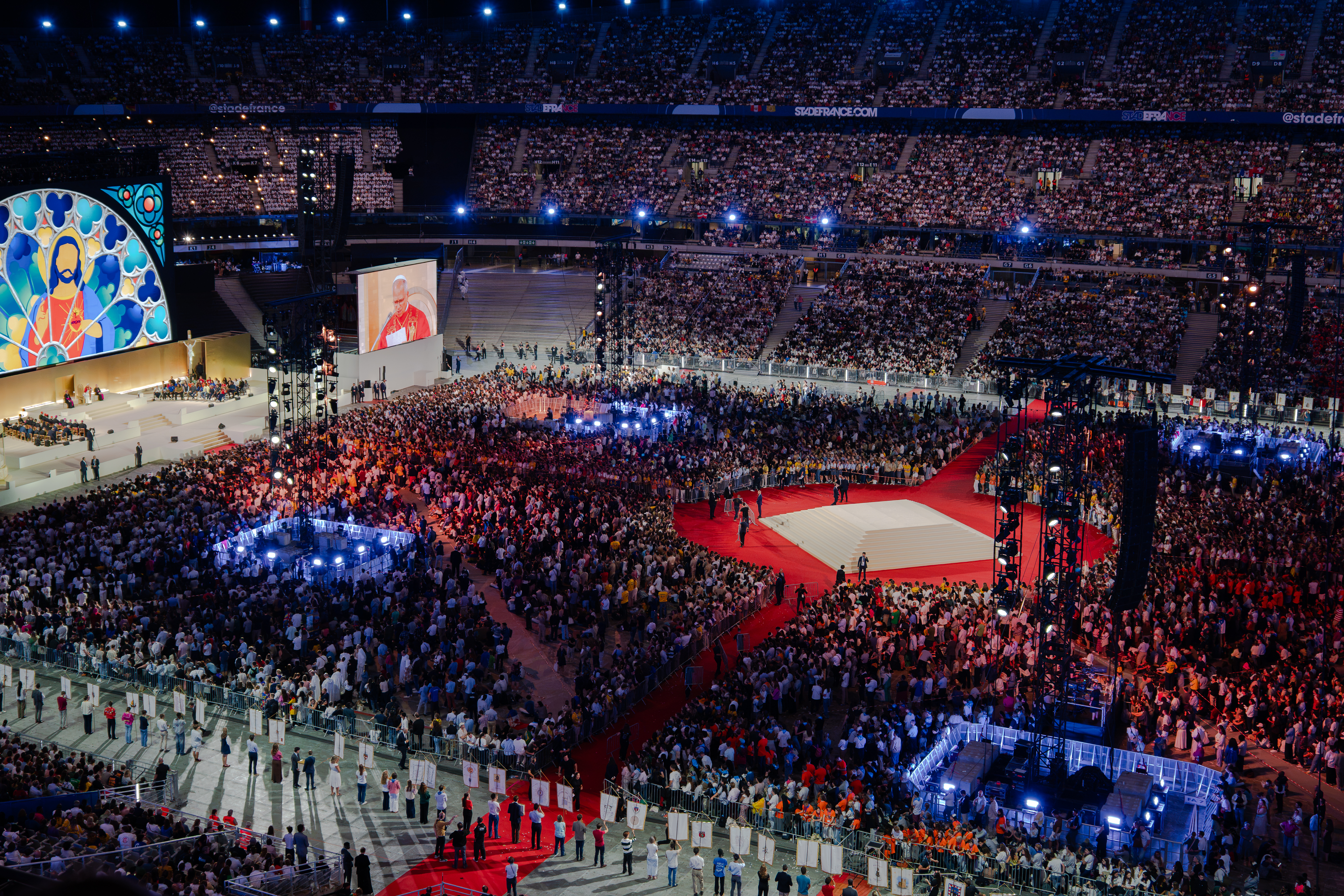
The vigil at the Stade de France called for a different setup. A central LED screen measuring more than 400 m², complemented by additional screens, formed part of a system that also included sound, lighting and production control. Both setups served the same purpose: enabling worshippers to see and hear the celebrations wherever they were in the audience.
Welcoming the public in a major urban settin
For the Mass, more than 200 lightweight temporary structures housed public reception, first aid and event operations. More than 2,500 sanitary facilities were provided for the general public, with additional facilities for people with reduced mobility, the press, VIP guests and event staff.
More than 6 km of barriers helped define zones, protect installations and guide the movement of crowds. Up to 300 handheld scanners could be used to check entry. Signage and accessible routes complemented these measures to help welcome worshippers of all ages.
Providing the power and connectivity behind the even
Power, networks and telecommunications kept the sites running. The digital infrastructure included 100 Wi-Fi access points, wired and high-speed networks, and 4G and 5G antennas, supported by network monitoring and cybersecurity measures.
Media coverage also required dedicated facilities, including press stands, camera platforms and television studios, as well as dedicated power and connectivity. Their installation had to account for technical constraints, the space available and the protocol requirements of each part of the programme.
Coordinating the details so worshippers could focus on the célébration
From the Institut catholique de Paris to Notre-Dame Cathedral and its forecourt, and from public spaces across Paris to the Stade de France, GL events adapted its work to the layout and use of each location.
Working with the Diocese of Paris, public authorities and teams on the ground, GL events brought together a wide range of specialists within a tight timeframe. Their work enabled worshippers to gather, follow the celebrations and hear the Holy Father’s words, giving them the space to experience the spiritual meaning of the visit.
Photo Crédits: Nicko Guihal et Mahdi Aridj
What role did GL events play during Pope Leo XIV’s apostolic visit?
For the apostolic visit from 25 to 28 September 2026, GL events supported the Diocese of Paris in planning, preparing and delivering the public gatherings on the Paris programme. Over three months, its teams coordinated the temporary infrastructure, audiovisual systems, power, networks and facilities needed to welcome worshippers.
Which sites did GL events work across during the papal visit?
GL events worked at the Institut catholique de Paris, at Notre-Dame Cathedral and on its forecourt, and at the Stade de France for the vigil. For the Mass, the setup extended from Place de la Concorde to Avenue de la Grande-Armée, via the Champs-Élysées and Place de l’Étoile.
How could worshippers follow the celebrations from further away?
For the Mass, GL events deployed more than 40 large-format screens along the route from Place de la Concorde to Avenue de la Grande-Armée. For the vigil at the Stade de France, a central LED screen measuring more than 400 m², together with additional screens, allowed worshippers to follow the celebration from the stands.
How were worshippers welcomed and guided through the site for the Mass?More than 11,000 seats were provided in the stage and audience areas. More than 6 km of barriers helped define zones, protect installations and guide people through the site. Signage and accessible routes for people with reduced mobility complemented these measures.